The pass arrives just inside the offensive blue line. You settle it in the middle of the blade, look through two bodies, and keep the shot below the defender’s knees. A P88 can make that feel wonderfully ordinary.
Next shift, the puck finds you beside the net. You pull it toward the toe and try to lift it immediately. Now it takes more work from your hands.
That is the P88. It suits players who work through the middle of the blade and prefer to create lift themselves. Compared with a P92/P29 or P28, its more neutral face and mid-blade pocket give less help cupping the puck at the toe or lifting it quickly. Some players value that control. Others want the blade to do more.
In the August 2026 lineups we checked, the P88 appeared less often than the P92/P29 or P28. If you can find it in your size and flex, judge it by how the puck behaves in your game.
Pattern codes only get you close
“P88” names a pattern family. Each brand uses its own mould.
Bauer describes its P88 (opens in a new tab) as a medium-length, round-toe mid curve with an open face. CCM calls its P88 (opens in a new tab) a medium-sized mid curve, but describes the face as closed. Warrior’s W88 (opens in a new tab) has a closed face and semi-square toe. TRUE calls its version T88, formerly MC (opens in a new tab): a mid curve with a slightly open face and round toe.
Lie describes the angle between the shaft and blade when the bottom of the blade is on the ice. Within one brand, a higher published number generally places the shaft more upright.
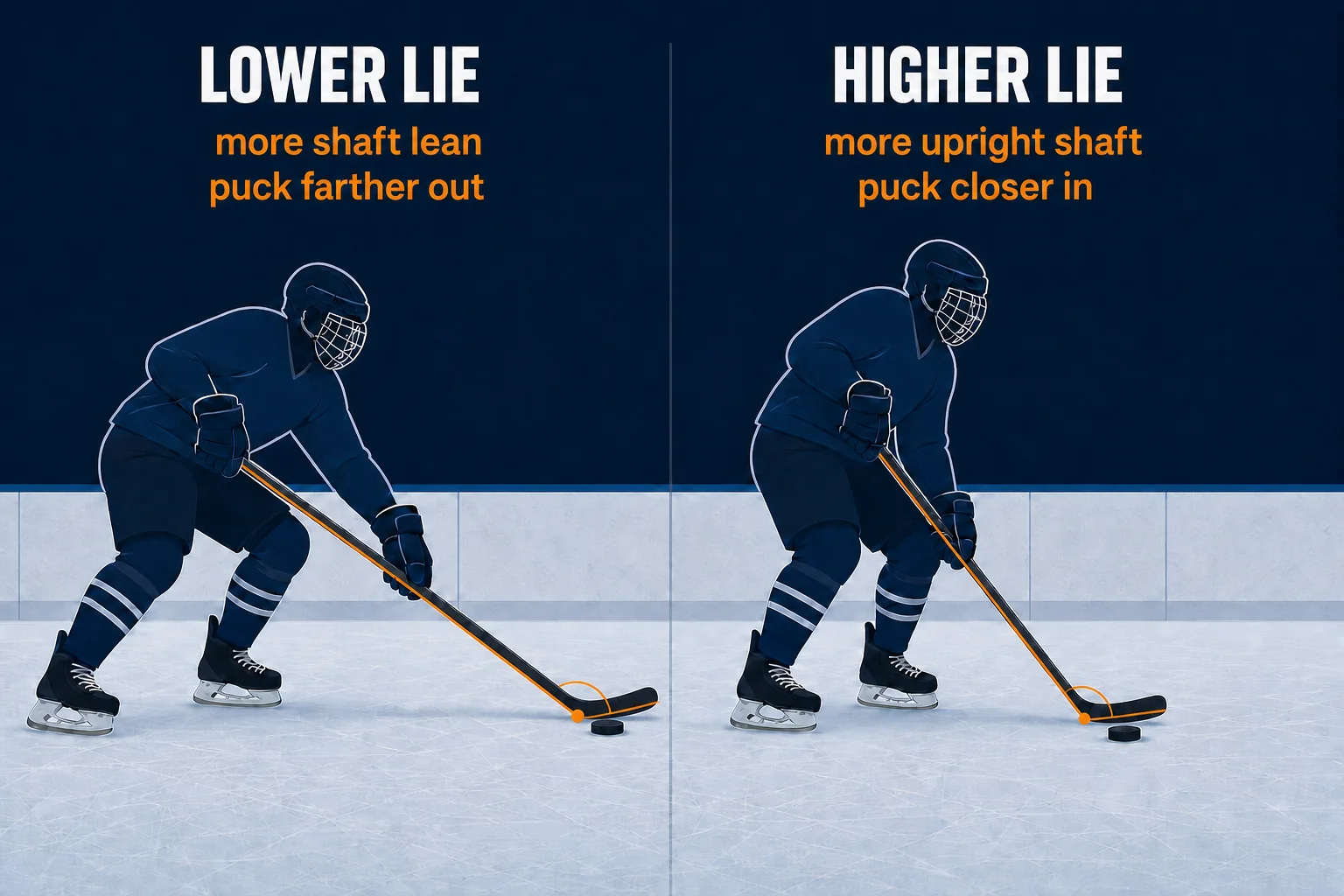
The orange arc marks the blade–shaft angle at the heel. AI-generated illustration, not to scale. Lower lie often pairs with more shaft lean and the puck farther out; higher lie often pairs with a more upright shaft and the puck closer in. Stick length, blade rocker and skating posture still affect the fit.
Scroll horizontally to compare all columns
| P88-family pattern | Published lie |
|---|---|
| Bauer P88 (opens in a new tab) | 6 |
| CCM P88 (opens in a new tab) | 5.5 |
| Warrior W88 (opens in a new tab) | 4 Junior; 5 Intermediate/Senior |
| TRUE T88, formerly MC (opens in a new tab) | 5 |
Lie numbers are most useful within a brand. Blade rocker and the rest of the mould still affect how much of the blade touches the ice. At the same finished stick length, a higher lie generally suits a more upright shaft position. A lower lie gives the player more room to carry the puck away from the body.
A Bauer P88, CCM P88, Warrior W88, and TRUE T88 share a shopping category, but they can feel different on the ice.
When switching brands, treat the equivalent-pattern code as a starting point. Put the blades together and compare:
- the face angle from heel to toe;
- the rocker along the bottom of the blade;
- blade length and height;
- where the curve becomes most pronounced; and
- how the blade lies in your normal skating posture.
Across brands, the common shape is a pocket through the middle of the blade and much less of the open, hook-like toe found on more aggressive shooting patterns.
Watch where the puck wants to go
With a P88, most of the work happens in the middle third of the blade. Start a wrist shot there and roll it through the pocket, and the release can feel orderly and predictable. The same pocket works well for compact touches without steering everything toward the toe.
The Bauer P92, CCM P29, Warrior W03, and TRUE T92 family opens more toward the toe. It offers more help when the puck is pulled inward and released farther forward.
The P28’s curve and openness concentrate closer to the toe (opens in a new tab), rewarding players who move their hands ahead of the body, pull the puck into a shooting pocket, and release from the front portion of the blade.
Try the same move with a P88 and the puck may feel less securely cupped. Toe drags and pull-and-release shots still work, but your hands do more of the work.
Shooting: why the P88 tends to launch lower
One video compared the P88, P92, and P28 (opens in a new tab). The reviewer launched the puck lower with the P88 than with the P92, and especially the P28. Players describe the same tendency (opens in a new tab). These are useful observations, although they are not controlled test results.
With a P88, quick elevation may take a more deliberate open face and wrist finish. With a P92 or P28, keeping a shot low through traffic may take more attention. Technique can overcome either tendency through hand position, blade angle, pressure, and release point. The curve changes how much effort each adjustment takes.
The P88 may suit you if you often shoot through traffic, want the puck below knee height, or take longer wrist shots from the middle of the blade. It may also help if open curves send too many slightly mistimed shots high.
It is less helpful when much of your offence begins near the net and needs immediate elevation. An open toe can make those shots easier.
Blade curve does not set shot speed by itself. Flex, stick length, kick point, shaft loading, and timing all affect the release. If a P88 shot feels weak, look at where the player loads and releases the puck before blaming the pattern.
Passing and backhands
Players who like the P88 often mention passing, receiving, and backhands.
One review (opens in a new tab) and player discussions describe predictable forehand reception, flat passes, and comfortable backhands. The less-open face gives the puck a fairly neutral surface through the middle of the blade. That area can feel broad and predictable when receiving or passing on either side.
They are player experiences, not universal results. Some players have excellent backhands with P92 and P28 patterns; others dislike the P88’s lie or rocker. Technique and blade contact still matter.
The more open face of a P92/P29 may make a rising saucer pass easier by adding initial loft. A P88 can make the same pass, but a newer player may need to create more elevation and spin with the hands.
The P88’s stable pocket can feel excellent when you carry through the middle, make compact touches, protect the puck with your body, and move it quickly into passes. A game built around toe retrievals, toe drags, and pull-and-release shots may expose the reduced toe hook.
Watch your hands in an unopposed drill. If the puck spends most of its time between the heel and middle, the P88 deserves a look. If nearly every attacking move ends at the toe, expect an adjustment.
What this means for young players
Some people say the P88 “teaches proper technique.” We found no evidence that a blade curve can do that by itself.
Because the pattern supplies less automatic loft, a young player may learn to control face angle and finish the shooting motion. But the curve cannot be judged apart from stick length, flex, and the player’s ability to load the shaft.
If a junior player cannot lift the puck, check the whole setup:
- Can the player flex the shaft during a normal shot?
- Has cutting the stick made its effective feel too stiff?
- Does the blade sit reasonably flat in the player’s normal stance?
- Is the puck being pushed, or does it travel along the blade before release?
- Has the player used one setup long enough to develop repeatability?
Moving to a P28 may produce faster elevation without solving the underlying problem. Keeping a P88 to “force” development may not solve it either.
For a developing player, consistency usually matters more than changing patterns every few months. P88, P92, and P28 can all work when flex, length, and technique make sense. Choose a pattern the player can find again and use long enough to understand.
Can you find another one?
In August 2026, Bauer offered P88 on the PULSE Senior (opens in a new tab), other senior sticks, and selected junior configurations. It was missing from some premium junior selectors. CCM offered P88 (opens in a new tab) in current lines. Warrior sold W88 (opens in a new tab), while Sherwood offered PP88 on the Rekker Youth (opens in a new tab) and a senior model.
TRUE documented T88/MC in its curve information, but we could not find it across the brand’s current flagship retail selectors. That does not mean TRUE has formally discontinued it.
Before committing, check whether your hand, flex, length, and price are available where you shop. Keeping the P88 while settling for the wrong flex or an over-cut stick can erase the reason you liked the curve.
Who should use a P88?
Position is a poor shortcut. A modern defenceman may release from the toe, while a winger may build a game around low passes, retrievals, and backhands. Your repeated puck actions tell you more than the letter beside your name on a lineup card.
Start with three questions:
- Where does the puck live? If you naturally carry and release it through the middle of the blade, P88 geometry is working with you. If you depend on toe pulls and toe-release snapshots, P92/P29 or P28 geometry may ask less of your hands.
- What goes wrong now? If shots climb or sail when you miss slightly, the P88 may help. If the puck escapes the toe or will not rise quickly enough in tight, another pattern may feel easier.
- Can you buy the same setup again? Confirm the right hand, flex, length, and price before committing. The right curve on the wrong shaft is still the wrong stick.
If you can compare curves, keep finished length, flex, and kick point similar. Test ordinary game actions:
- receive firm passes on both sides;
- collect pucks from the boards;
- make flat and saucer passes on the forehand and backhand;
- shoot low and high from the middle and toe at several distances; and
- record misses, bobbled receptions, and unwanted elevation.
A new curve can feel brilliant when the first few shots fly high. Judge it by the actions you perform most, including the misses and bobbled passes.
Already trust a P88 and cannot name a problem it is failing to solve? Keep playing. That is evidence, too.
The P88 may suit players who work through the middle of the blade, value comfortable passing and backhands, and want more deliberate control of shot height.